Celebrate Naturalizing Bulbs in the Winter Garden - Part 2
Celebrate Naturalizing Bulbs in the Winter Garden Part 2
By Amy Sanderson, Doris Page Winter Garden Volunteer
Each year we renovate a bed or two with the help of some of the wonderful students. Sometimes there is a shrub or some ferns we rescue and move, but usually the only thing we prioritize saving are the bulbs and corms. Our new planting schemes never aim to squeeze in as many deciduous perennials as possible for summer interest, or to cover the ground with evergreens, because it is more important that they share space with winter and spring bulbs that also need to flower and photosynthesize. Every new planting scheme includes hundreds of old bulbs, and usually some new ones too, and in that way we never lose the cottage charm that Doris Page preached. 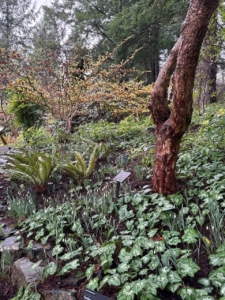
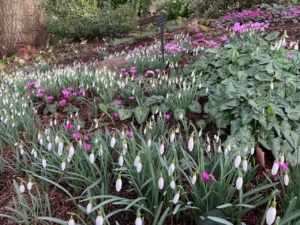
Naturalizing bulbs can be a passive act, letting a single snowdrop gradually accumulate into a clump by its own offsets and seeding, or the gardener can actively play a role through lifting, dividing and replanting into new areas, or scattering seed. We are mostly passive naturalizers, early investments a few decades on, now pay ample dividends, but when we do wish to increase our holdings, or need to replant, we aim for two things: a coherent multitude, with just enough random placement to imply the necessary age and shambolic approach to maintenance that defines the best cottage gardens.
All around we have inspiration for how bulbs place themselves when given the chance: the river of Cyclamen coum whose seeds have gradually rolled to a stop and germinated down a steep bank; the snowdrop clumps that are spaced at the height of the flowering stem as it falls, laden with seed; the anemones that spread like a thick crust through all their companion plants, whether in sun or shade.
In winter, when things are lush and green, it is easy to forget that the Winter Garden is also technically a low water demonstration garden. Many winter flowering shrubs and perennials have traditionally come from temperate climates with regular summer moisture.
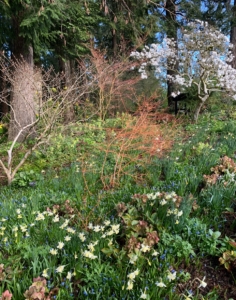
Our hotter and drier summers are forcing us to gradually change our plant palette, but thankfully, the bulbs are already adapted to thrive in summer drought. In fact, they depend on having dry, well-drained soil during their dormancy, when they’re most prone to rotting.
Every week from now, until late May, we will enjoy a succession of bulbs, flowering in quantity, sometimes in the most unexpected and random places, that remind us of the great joy of the garden: that it is a living, changing, immersive piece of art that we can take great pleasure in tending, in observing, in cherishing for the future, whether it is at rest or in full winter song.
